
VITALITY, MYSTERY, AND FEROCITY: A Breakdown and Analysis of Goro Majima's Tattoos
written on my tumblr blog in 2021
In the summer of 2021, I went on a spree of checking out dozens of nonfiction books (largely art and fashion history) from my local library and reading them all. One notable book among these was one on the history and culture behind Japanese tattooing, mainly the tradition of irezumi.
I chose this book because my interest in irezumi had been sparked by the Yakuza/Ryu Ga Gotoku series of video games, which feature many such tattoos and even sometimes explore the symbolism of each tattoo and show us where these tattoos are made. And as for this book, although the cover art gave me pause (Anime tattoos? Non-irezumi? Western pop-culture influence? Western author? Big frown. This doesn't look reliable as a source...) it ended up being far more in-depth and well researched than expected, and I learned a lot. I couldn't help myself from infodumping my findings for others in the Yakuza fandom to read. Here is the introductory section of my Tumblr post, reformatted to suit this essay's style (proper punctuation and capitalization):
"Turns out that book on Japanese tattooing history is a real page turner. It’s a big book and I blasted through a good third of it in a couple hours, reading aloud (hyperfixation powers activate). I’m learning so much but also confirming a lot of my anxieties about why I might not be able to design my own irezumi for my silly fan purposes because, to paraphrase the way the book eloquently puts it, irezumi (or the art of traditional Japanese tattoo design) is a visual language that has its own grammar and syntax, and you have to take time (sometimes decades) to properly learn it before you can properly create new metaphorical words, sentences, and stories using the complex lexicon of established symbols. Making mistakes, whether by unintentional blunder or by uninformed decision, can change the whole meaning of a tattoo, and could be disastrous.
That said, I’m not creating a tattoo to go on a real person. The stakes are far lower. But i do want to be careful and respectful while playing with something that’s not from my culture."
(For further context: at this point I was considering designing an irezumi tattoo for one of the characters in the series who didn't have one, for alternate universe development purposes. Hence my discussion of design anxieties and respect. I wanted to avoid cultural appropriation or otherwise cultural insensitivity at all costs. This isn't relevant to the essay to come, but I felt it important to include for fuller context before we really get into the details. The takeaway I want readers to have is that irezumi isn't something the creators of Yakuza made up, and it's not something non-Japanese people can just pick up and play with without prior understanding of its history and significance.)
"In addition to helping me dream up new irezumi, this book is also turning out to be helpful in unraveling the irezumi donned by Yakuza characters. Most are given just one big back tattoo with one thing on it (which is perfectly common and normal, it just means something a lot simpler, because, to use the language metaphor [from earlier], it’s simply a word instead of a sentence. Kiryu and his dragon, and Saejima and his tiger, are simple, but powerful).
But [Goro] Majima, with his complex mix of several different visual elements, creates a very interesting tableau of meanings."
Without further ado, let's get into it! From this point on, nearly all text will be drawn directly from the post itself, simply reformatted.
 |
 |
|---|---|
| Majima's tattoos (backside) - Kizuaki Kitamura (also known as HORITOMO) | Majima's tattoos (front and arms) - Kizuaki Kitamura |
Right, so! What are we looking at here? Well, we see the Hannya of course, plus the twin snakes and sakura, enveloped in swirling waves and clouds. The tattoo is rendered in three ink colors in varying saturation: black, red, and yellow, with hints of green for the sakura leaves. Black and red are very traditional, even ancient tattoo pigments, and yellow relatively more modern. Green is so modern, some artists consider it disqualifying as irezumi, because it’s nontraditional. We also can see that the tattoo spans over his back, thighs, shoulders, chest, and arms. this is what’s known as a kame no kou (literally “tortoise shell”, referring to the back and thighs) and hikae (from hikaeru, or “to restrain oneself”, referring to the shoulders, chest, and arms). If the tattoo spread a little lower on the arm, past the elbow, the whole bodysuit would traditionally be referred to as simply shichibusode, but no, majima had to combine two different things, like a bisexual. See section below for correction/clarification on this point.
It’s been said in [another post of mine] that having a tattoo this large and elaborate is staggeringly expensive and time-consuming, which reflects directly on both the wealth of his patriarch who’s basically sponsoring him (and gets to keep the “canvas” of his skin in the event of his death), and also Majima’s endurance with pain; two of many reasons why yakuza get tattooed in the first place, but there are still many more.
Every visual element to this tattoo has a meaning individually, and woven together, creates even more meaning. I’ll try my best to elaborate on as much as I can, from my limited knowledge.
Swirling clouds and waves are typically employed as background elements to tie a whole piece together and complete the overarching design. The bokashi (or gradient effect) was developed in the 19th century with the rise of new printmaking techniques in the Ukiyo-e era, and are practically universal for creating these designs, but in general, wind and water have been popular in Japanese art since... forever. Or at least since their first cultural exchanges with China, many centuries ago. Clouds and waves don’t tend to have a symbolic meaning all on their own. They’re there for the purpose of being pretty, showing off the artist’s skill, and evoking nature.
The edges of the tattoo, comprised of these swirls, are what’s called bukkiri/butsu-kiri, or mikiri (borders) that look like they were sliced by a katana. This is especially evident on the most visible borders on his chest. I think they’re so eye-catching and iconic.
Beauty, of course -- cherry blossoms represent beauty. But! They can also take on other meanings depending on context, such as the fresh renewal of springtime or the impermanence of life (aka "mono no aware", “the sadness of things”). It historically has been a much more masculine symbol than feminine; like a warrior who lives fast and dies young. In addition, it’s very traditional to have sakura rendered in a bright red such as this, rather than their natural pink. They’re recognizable as sakura as opposed to say, ume (plum blossoms), because of the notch at the tip of each petal. They’re small on Majima’s tattoo, but they’re there.

A close up on one of the sakura petals in Majima's tattoo.
[This part is] complicated. Sometimes snakes represent sexuality, but often they have more in common with dragons, due to their visual similarity. Snakes can symbolize immortality thanks to the evocative, mythical imagery of shedding its skin, and surviving inhospitable winters. They’re also very closely associated with spring vitality, because that’s when they emerge out of their winter burrows, making them a suitable pair with sakura, though traditionally they’re more commonly depicted in tattoos with peonies.
However, these snakes are special because they are specifically white snakes, called shirohebi, which are rare, worshipped within the Shinto religion, and symbolize good fortune.
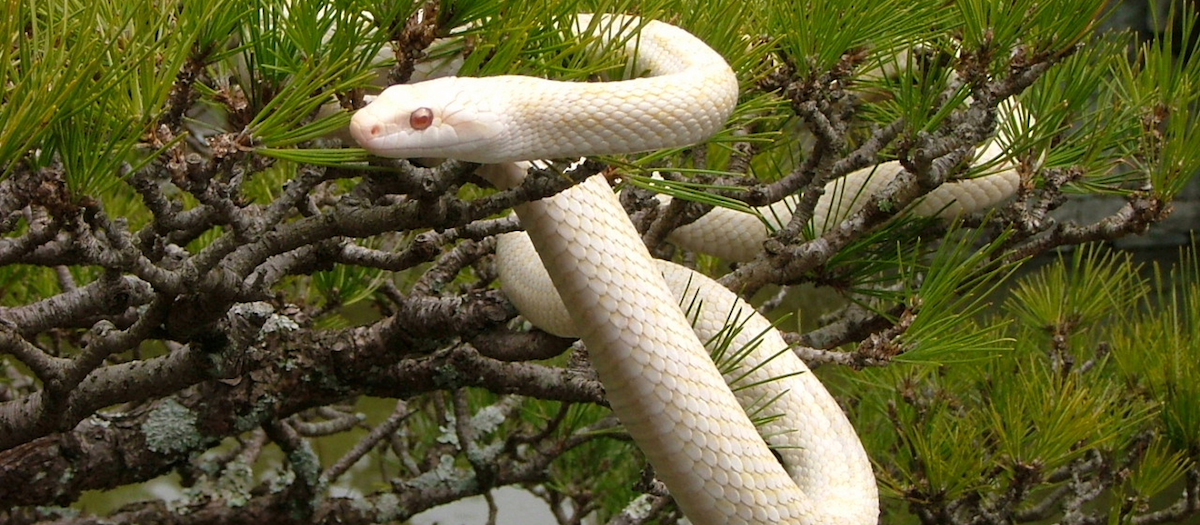
A white snake. Image sourced from shirohebi.info
This is the most complex thing to interpret of all. Hannya, as most Yakuza fans already know, are a type of demon, originating in folklore and appearing often within Japan’s rich noh theater history, through the use of masks. Furthermore, as with most Hannya tattoos, Majima’s tattoo technically isn’t a depiction of the demon herself, but a Hannya mask, though the two are pretty much synonymous in meaning. Also, fun fact, the color of a Hannya mask has implications of its own! This one is white, which implies high status.
Hannya are known for transformation (most obviously, beauty into terror, as an attractive woman that transforms into a man-eating monster). This is even supported by the iconic way physical Hannya masks are constructed – the angle you view them from can drastically change the facial expression of the Hannya, from rage to jealousy to sorrow. (That’s why noh masks are so great for theatrical purposes!) Also, some associate Hannya demons with wisdom, considering the name “Hannya” can be traced back to the Buddhist notion of hannya (般若, “wisdom”), though some believe this to be coincidence.
As an aside, many Japanese demons have horns, and there’s a reason for that! Horns symbolize anger in Japanese culture, even today. Anyway, take that how you will in this context.
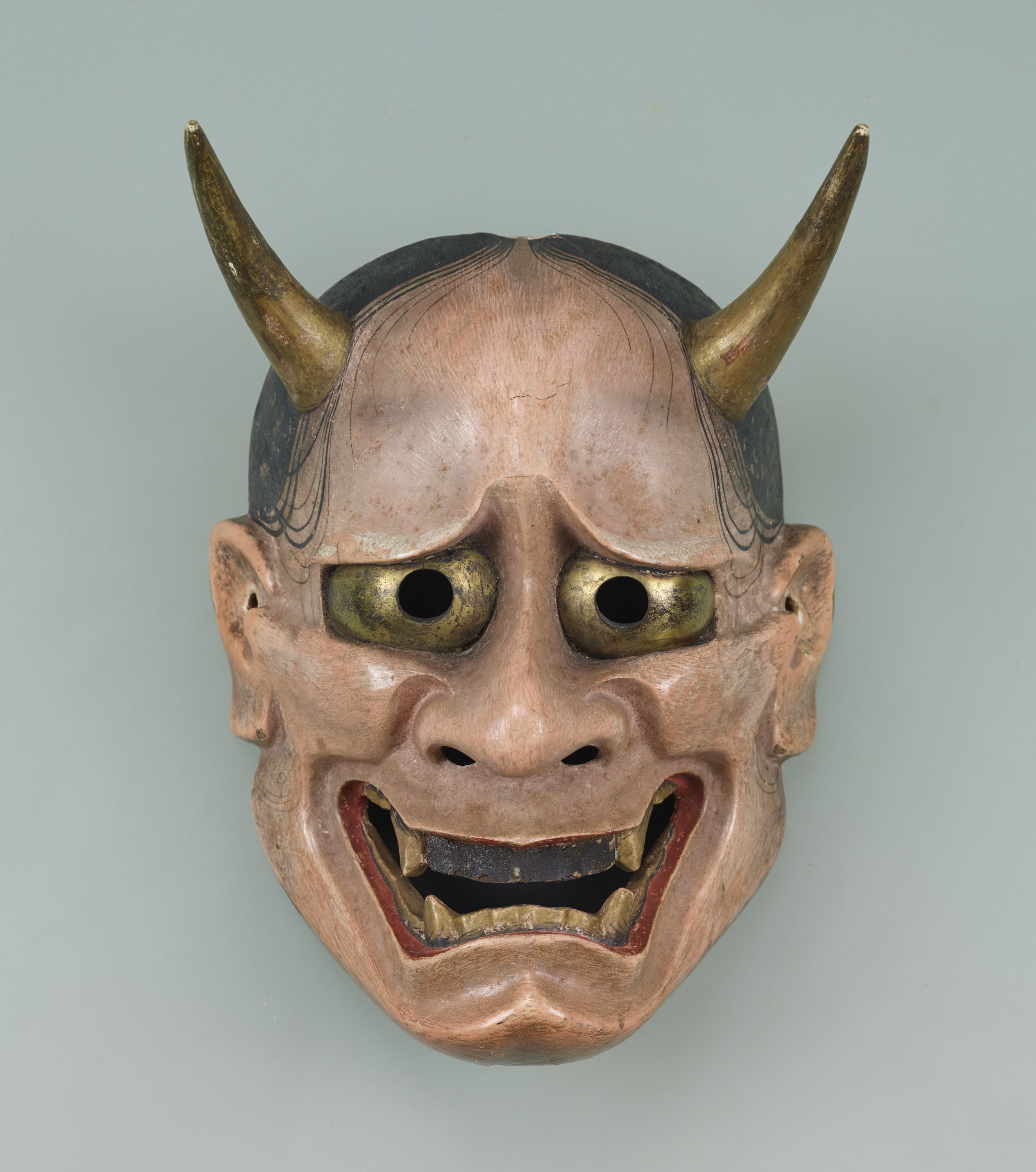
A Hannya mask. Image sourced from Wikpedia
Central, repeating themes I’ve noticed here are of vitality/tenacity, a unique balance of masculine and feminine, mystery (the mythicality of the shirohebi and Hannya, plus the hypnotic swirls of water), and fierceness (sharp teeth and horns, blood red sakura). From the Hannya mask alone, we can certainly pick up connotations of theatricality, fearsome rage, renown and reputation, potential wisdom, and complexity. The shirohebi also seem to communicate the message, “I’m a rare breed”. Plus, good luck, of course. Having two of them also makes me think of how he has two distinct “sides” - the "mad dog" persona and Goro Majima, the person.
Another thing I learned is that the strip of bare skin visible in irezumi sleeves, from the armpit downward, actually has a purpose! Or, rather, historically it did, and now it’s just part of the tradition.

Closer...

There we go. (Image sourced from the Yakuza Wiki.)
Believe it or not, that little strip of un-inked skin is what I’m talking about here.
So, a big part of early Japanese tattooing history is punitive in nature. That is, marking criminals with bands around the arms or derogatory terms on their foreheads or other visible parts of the body as a form of punishment. People saw the tattoos and immediately knew them to be criminals, treating them accordingly to the customs of the time. Eventually, criminals started getting cheeky and tattooed prettier imagery, the kind that was already used to adorn the bodies of physical laborers, around the punitive tattoos to make them nice to look at, or camouflage them altogether.
Eventually, irezumi became fashionable in the 18th and 19th centuries among the upper class that could afford them just for show. However, in order to show that they weren’t criminals hiding punitive tattoos, they would leave that strip of uninked skin, proving that they had no banded criminal mark on the arm. Now it’s sort of ironic for yakuza to have that blank strip, considering their career!
I initially thought the shape of [Majima's] tattoo as a whole was a weird mix of two things, but it turns out it’s an established one, called gobusode (or, the five-tenth sleeve bodysuit. ...Why not call it half sleeve?). That’s like the shichibusode I mentioned before, just with sleeves ending above the elbow. My bad! (Note: I preserved the mistake in the original essay for purposes of flow, but also felt it very important to include the correction for purposes of verity.)

If he took off his pants, you'd see the tattoo spans down his buttocks and halfway down his thighs as well. (Screenshot of Majima's back from Yakuza 0.)
And there you have it! The content above comes from three separate Tumblr posts made over the course of a few days. It feels good to collate them into a single written piece. It's not as formal and proper as my academic papers (that have proper in-text citations and whatnot), but I didn't feel it necessary for fandom analysis such as this. I hope this was interesting and informative to read! And if you have any questions, comments, or especially corrections you'd like to suggest, send me an ask or PM over Tumblr. I highly recommend reading Japanese Tattoos by Brian Ashcraft and Hori Benny for more detailed and extensive information on irezumi, its symbolic lexicon, and its history and culture, if this sparked an interest for you.